

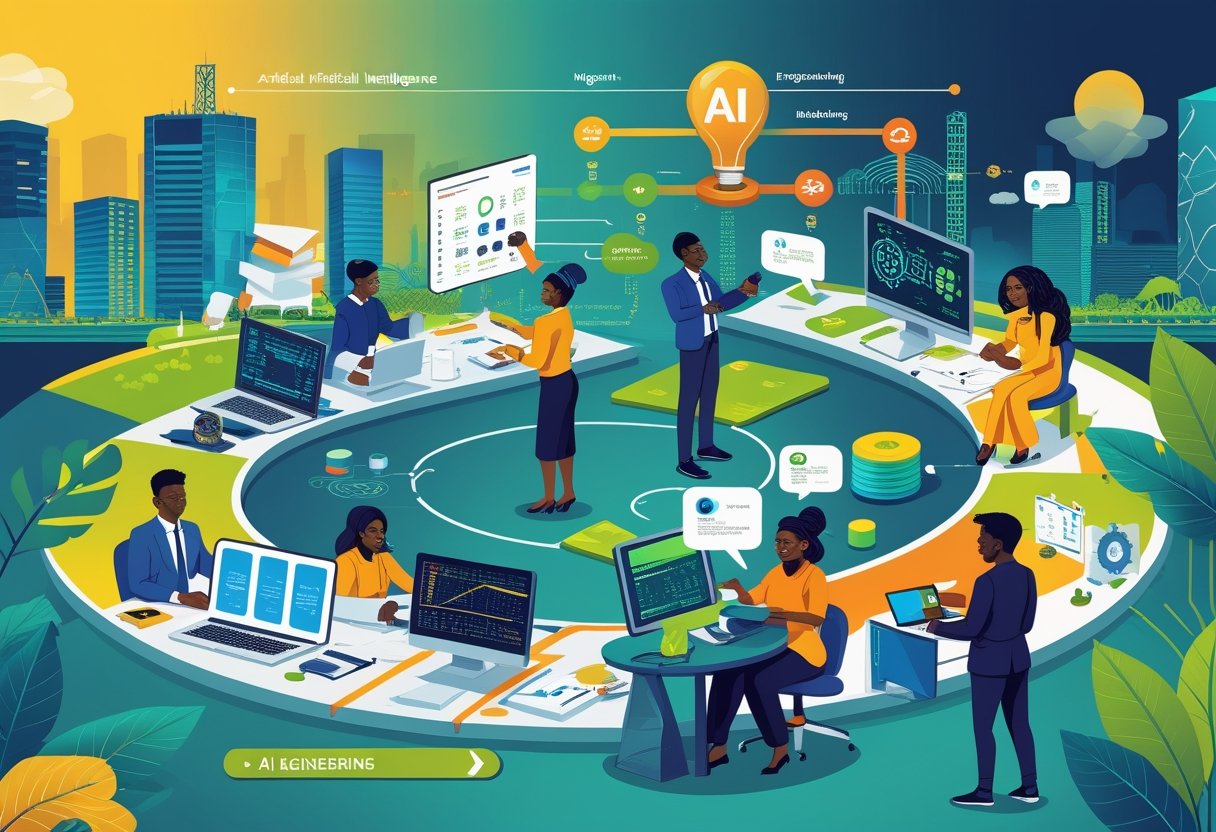
Demand for skilled AI professionals continues to rise as the technology becomes more advanced. You can see it everywhere: companies want people who can make sense of data and build intelligent systems.
This guide provides practical steps to break into the AI field. It highlights eight job paths that fit different strengths and interests.
You’ll also spot current hiring trends, such as the rise of remote roles, growing concerns about data privacy, and new programmes designed to boost technical skills across Nigeria.
Key Takeaways
- AI is growing fast and showing up in all sorts of industries.
- Clear entry points and varied roles mean there’s something for a wide range of skill sets.
- Remote jobs and training programmes are opening up more opportunities.
What artificial intelligence does
Artificial intelligence uses computer programs and algorithms to handle tasks people usually do. It learns from data, spots patterns, and makes decisions.
Generative AI can even create new stuff-like text or images-by predicting what should come next. The more feedback and data it gets, the better it performs. AI systems can achieve human-level performance on specific tasks, but they don’t think the way people do.
Artificial intelligence career path
1. Check if AI suits your strengths
Start by figuring out if AI actually fits your skills and interests. AI work usually calls for solid maths, logical thinking, and the ability to stick with challenging problems.
If you’re comfortable with computers, curious about new tech, and like working with others, that’s a good sign. Do you enjoy solving puzzles or picking up the basics of coding? Then AI might feel like the right path.
2. Get a relevant undergraduate degree
Most employers look for at least a bachelor’s degree in something related. Popular options include computer science, software engineering, data science, IT, robotics, or business analytics.
If you want to go deeper, a master’s degree can open doors to more technical roles. It’s not always required, but it definitely helps in some cases.
3. Build hands-on AI and machine learning skills
Getting practical experience matters as much as what you study in class. Learn to code-Python is a solid choice—and try prompt engineering for generative AI.
Experiment with models and datasets. You could join a university tech club, grab an internship, or work at a startup. Short courses, like the Microsoft 3Mtt AI readiness course or a generative AI bootcamp, can speed up your learning and show employers you’re serious.
Suggested learning path:
- Pick up Python and basic statistics.
- Complete machine learning and generative AI projects.
- Try prompt engineering on fundamental tools, then share your work on GitHub.
- Take short, recognised courses like Career Essentials in generative AI to boost your CV.
Keep track of your projects and internships to show what you can do when you apply for jobs. Employers like seeing tangible evidence of your skills.
Related: AI Researcher Job Description
8 artificial intelligence jobs
1. AI strategy adviser
An AI strategy adviser helps organisations plan and launch AI projects. They review current systems, recommend tools, and lead teams in integrating AI into business workflows.
Key tasks:
- Audit IT and data setups.
- Build roadmaps for adopting AI.
- Train staff and manage organisational change.
Skills and tools:
- Project management and clear communication with stakeholders.
- Understanding of cloud platforms and basic machine learning concepts.
2. Business insights analyst
A business insights analyst uses AI tools to turn company data into smart decisions. They build dashboards, forecast trends, and track key metrics, such as ROI, to help leaders steer the ship.
Key tasks:
- Analyse sales, costs, and performance numbers.
- Create visual reports and predictive models.
- Advise on strategy by spotting patterns in data.
Skills and tools:
- SQL, Excel, BI platforms (Power BI, Looker).
- Basic statistics and data visualisation know-how.
3. Hardware systems engineer
A hardware systems engineer designs and tests the physical computing parts that AI systems need. They research materials and architectures to make things faster and more efficient.
Key tasks:
- Create and test circuit boards, memory systems, and GPUs.
- Check thermal, power, and performance features.
- Work with software teams to match hardware to workloads.
Skills and tools:
- Electrical engineering, CAD tools, and hardware testing gear.
- Understanding what AI workloads require.
4. AI research scientist
An AI research scientist explores new algorithms and methods to advance machine intelligence. They publish what they find, build prototypes, and test out new ideas.
Key tasks:
- Read up on the latest research and run experiments.
- Propose and test fresh algorithms.
- Work in research labs, academic or corporate.
Skills and tools:
- Strong maths, stats, and programming (Python, PyTorch, TensorFlow).
- Solid research skills and scientific writing ability.
5. Autonomous systems engineer
An autonomous systems engineer builds robots and machines that use AI to sense and act in the real world. They blend mechanics, control systems, and perception models to make reliable devices.
Key tasks:
- Design mechanical parts and control systems.
- Add sensors and machine learning for perception.
- Test devices in unpredictable, real-world settings.
Skills and tools:
- Robotics frameworks (like ROS), control theory, and sensor fusion.
- Teamwork with software developers and ML engineers.
6. Applied data scientist
An applied data scientist prepares and explores datasets to help AI perform better. They clean, model, and interpret data so that teams can make evidence-based decisions.
Key tasks:
- Collect, clean, and analyse large datasets.
- Build models to assess how AI behaves and the results it produces.
- Share findings through reports and visuals.
Skills and tools:
- Python or R, machine learning libraries, and data visualisation.
- Know-how in designing experiments and evaluating results.
7. Data infrastructure engineer
A data infrastructure engineer builds the pipelines and storage systems that keep AI models running. They ensure data flows smoothly from sources to analysis and production.
Key tasks:
- Design ETL pipelines and data warehouses.
- Keep up data quality, scalability, and security.
- Optimise systems for heavy AI workloads.
Skills and tools:
- SQL, distributed systems, and cloud data services (AWS, GCP, Azure).
- Experience with stream processing and data modelling.
8. Machine learning developer
A machine learning developer builds and launches learning models so systems can adapt and get smarter. They usually team up with software engineers and data folks to push models into real-world use.
Key tasks:
- Implement and train machine learning models.
- Validate performance and guard against bias.
- Deploy models and monitor behaviour in production.
Skills and tools:
- ML frameworks, software development best practices, and CI/CD.
- Understanding of model evaluation, hyperparameter tuning and versioning.
Quick comparison table
| Role group | Focus | Typical partners |
|---|---|---|
| Strategy & insights | Planning, decisions | Business leaders, IT |
| Engineering & hardware | Physical systems | Software, testing teams |
| Data roles | Data prep and pipelines | ML engineers, analysts |
| ML development | Models and deployment | Data scientists, ops |
Salaries jump around a lot depending on where you are, your experience, and which company you land at. If you’re mixing software development with data science, you’ll need to code and have a good head for numbers-there’s no way around it. AI Career Paths for Nigerians

Oke O. Michael (HND, BA, MBA, MSc) is a tech-savvy professional with experience in sales, healthcare, digital marketing, and business development. A skilled editor and passionate web designer, he combines strong technical insight with creative problem-solving to deliver impactful digital and business solutions.