


Whether you’re a recent graduate or someone looking to switch careers, the opportunities in machine learning and AI engineering are accessible right now.
Understanding What AI Engineers Actually Do
AI engineers build intelligent systems that learn from data. They create machine learning models that power recommendation engines, fraud detection systems, chatbots, and predictive analytics tools.
In Nigeria’s growing tech ecosystem, AI engineers work across fintech companies, healthcare startups, agricultural technology firms, and e-commerce platforms. They solve real problems using data science techniques and deep learning frameworks.
The role combines programming skills with mathematical understanding and business knowledge. You write code to train models, evaluate their performance, and deploy them into production systems.
A typical project might involve building a credit scoring model for a fintech company. You’d collect data, clean it, select appropriate machine learning algorithms, train the model, and integrate it into the company’s loan approval system.
Core Responsibilities of AI Engineers
AI engineers spend their time on several key activities. Data preparation takes up a significant portion of the work, as models require clean, well-structured information.
Model development involves selecting algorithms, training neural networks, and fine-tuning parameters. You’ll experiment with different approaches to find what works best for each specific problem.
Technical Tasks
Engineers handle the practical implementation of AI systems in production environments.
- Writing and optimising machine learning code
- Training deep learning models on large datasets
- Deploying models to cloud platforms
- Monitoring model performance over time
Collaborative Work
Success requires working alongside diverse teams across different departments.
- Collaborating with data scientists on model design
- Working with software engineers for integration
- Communicating findings to business stakeholders
- Documenting processes and maintaining code
Problem Solving
Engineers identify opportunities where AI can create business value and address challenges.
- Identifying suitable use cases for machine learning
- Troubleshooting model accuracy issues
- Optimising algorithms for better performance
- Ensuring models remain ethical and unbiased
Continuous Learning
The field evolves rapidly, requiring ongoing skill development and knowledge updates.
- Staying current with new AI techniques
- Learning emerging tools and frameworks
- Reading research papers on the latest developments
- Experimenting with cutting-edge models
Industries Hiring AI Engineers in Nigeria
Financial technology companies lead AI adoption in Nigeria. They use machine learning for fraud detection, credit scoring, and personalised banking experiences.
E-commerce platforms employ AI engineers to build recommendation systems, optimise pricing, and improve customer service through chatbots. Agricultural technology firms use computer vision for crop disease detection and yield prediction.
Healthcare organisations apply natural language processing to medical records and diagnostic support systems. Telecommunications companies leverage AI for network optimisation and customer churn prediction.
| Industry Sector | Common AI Applications | Key Skills Required | Entry Opportunities |
| Fintech | Fraud detection, credit scoring, chatbots | Machine learning, data analysis, Python | High – many startups hiring |
| E-commerce | Recommendation engines, demand forecasting | Deep learning, natural language processing | Moderate – growing sector |
| Healthcare | Diagnostic tools, patient data analysis | Computer vision, medical knowledge | Emerging – specialist roles |
| Agriculture | Crop monitoring, disease detection | Computer vision, IoT integration | Growing – agtech expansion |
| Telecommunications | Network optimisation, customer analytics | Data science, predictive models | Stable – established companies |
Why You Don’t Need a Computer Science Degree
The traditional pathway through computer science isn’t the only route into AI engineering. Skills matter more than certificates in this field.
Many successful AI engineers in Nigeria studied mathematics, engineering, physics, or even completely unrelated fields like economics or biology. What they share is a dedication to learning the necessary skills.
Employers care about what you can build. A strong portfolio of machine learning projects demonstrates capability far better than a degree certificate alone.
Real Success Stories from Nigeria
Chioma studied accounting at the University of Lagos. After graduation, she discovered machine learning through online courses. Within eighteen months of focused study and project work, she landed an AI engineering role at a Lagos fintech startup.
Emeka graduated with a degree in mechanical engineering. His analytical background helped him grasp machine learning concepts quickly. He built several computer vision projects, shared them on GitHub, and now works as an AI engineer at an agricultural technology company.
These stories aren’t unique. The AI field values practical skills over formal credentials. Various AI career paths remain open to self-taught professionals who demonstrate genuine expertise.
Skills That Transfer from Other Backgrounds
Different educational backgrounds provide valuable foundations for AI engineering. Mathematics graduates already understand the statistical concepts underlying machine learning algorithms.
Engineering disciplines teach problem-solving approaches and systematic thinking. These skills apply directly to debugging models and optimising performance.
- Analytical thinking from science and mathematics programmes
- Problem-solving methodologies from engineering fields
- Statistical knowledge from economics or social sciences
- Logical reasoning from any quantitative discipline
- Research skills from academic backgrounds
- Domain expertise from specialised fields like medicine or agriculture
What Actually Matters to Employers
Hiring managers look for demonstrable skills rather than specific degree titles. They want to see that you can write clean code, understand machine learning concepts, and deliver working solutions.
A portfolio showcasing real projects carries more weight than academic transcripts. Companies value practical experience with tools like TensorFlow, PyTorch, and cloud platforms.
Your ability to explain complex concepts clearly matters enormously. AI engineers must communicate technical ideas to non-technical stakeholders regularly.
The most successful career transitions into AI engineering come from people who combine their existing domain knowledge with new technical skills. A pharmacist who learns machine learning brings unique value to healthcare AI projects.
Building Your Foundation: Essential Knowledge Areas
Starting your AI engineering journey requires establishing solid foundations across several key areas. You don’t need to master everything before beginning, but understanding these concepts helps you progress efficiently.
The learning path involves mathematics, programming, and machine learning fundamentals. Each area builds upon the others, creating a comprehensive skill set.
Mathematics for Machine Learning
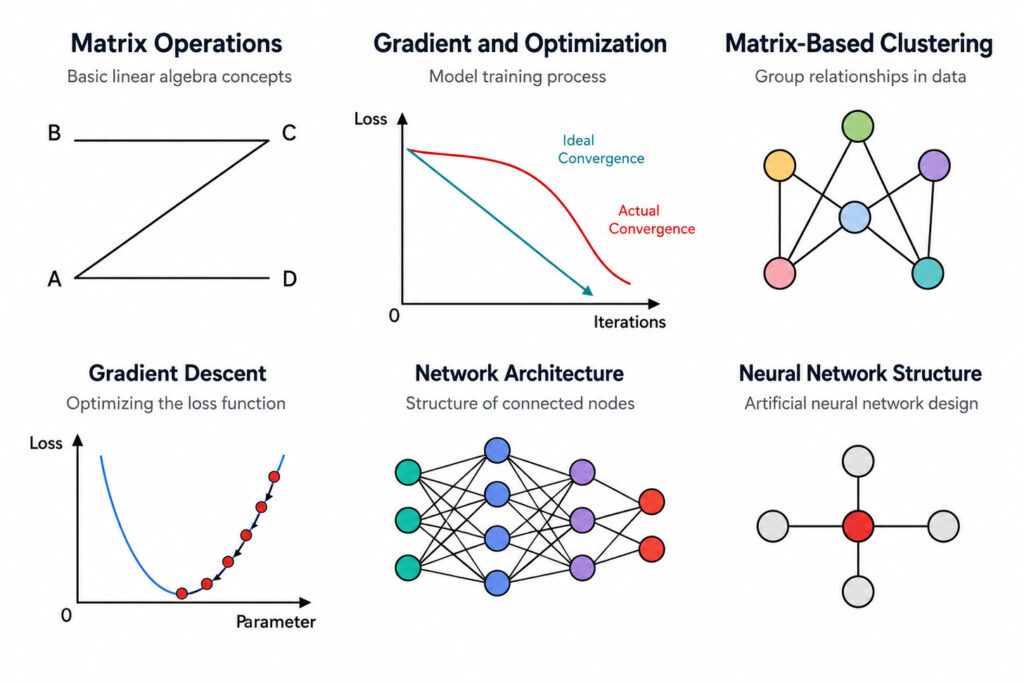
Mathematics forms the language of machine learning. You need a comfortable familiarity with several mathematical concepts, though you don’t require a mathematics degree.
Linear algebra helps you understand how neural networks process data. Matrices and vectors represent data transformations within models.
Calculus enables you to grasp how models learn through optimisation. Derivatives show how small parameter changes affect model performance.
Statistics and probability underpin nearly every machine learning algorithm. Understanding distributions, hypothesis testing, and Bayesian thinking proves essential.
Core Mathematical Concepts
- Linear algebra: matrices, vectors, transformations
- Calculus: derivatives, gradients, optimisation
- Probability: distributions, Bayes theorem
- Statistics: hypothesis testing, correlation
- Basic discrete mathematics and logic
Recommended Learning Resources
- Khan Academy for foundational mathematics review
- 3Blue1Brown YouTube channel for visual explanations
- Mathematics for Machine Learning book (free online)
- StatQuest YouTube channel for statistics
- Coursera’s Mathematics for Machine Learning specialisation
Programming Skills and Languages
Python dominates AI engineering work. Nearly every machine learning framework, library, and tool supports Python as the primary language.
Start with Python basics: variables, data types, functions, and control structures. Move on to object-oriented programming concepts and common libraries.
NumPy handles numerical computations efficiently. Pandas simplifies data manipulation and analysis. Matplotlib and Seaborn create visualisations.
Learning these libraries well saves enormous time later. Most AI engineering work involves data preparation and analysis using these exact tools.
- Learn Python fundamentals through practical exercises
- Master NumPy for numerical operations on arrays
- Study Pandas for data manipulation and cleaning
- Practice Matplotlib and Seaborn for visualisation
- Understand basic SQL for database queries
- Familiarise yourself with Git for version control
Introduction to Machine Learning Concepts
Machine learning divides into supervised learning, unsupervised learning, and reinforcement learning. Each approach suits different types of problems.
Supervised learning uses labelled data to train models. Classification problems predict categories, whilst regression problems predict continuous values.
Understanding fundamental algorithms provides the conceptual foundation. Decision trees, linear regression, and logistic regression form the building blocks.
Deep learning represents a subset of machine learning using neural networks. These models excel at complex pattern recognition in images, text, and audio.
Don’t rush through the foundations. A solid understanding of basic concepts makes advanced topics much easier to grasp. Many self-taught engineers struggle later because they skipped fundamental knowledge.
Your Structured Learning Path: Step by Step
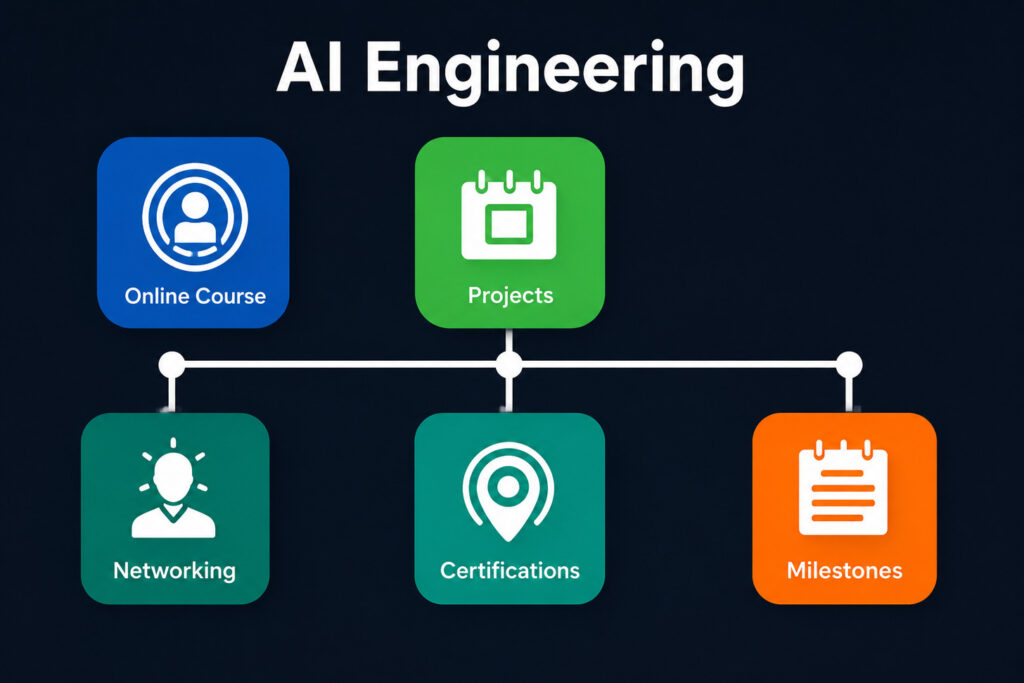
Following a structured path prevents wasted time and confusion. This roadmap takes you from a complete beginner to a job-ready AI engineer.
The journey typically takes twelve to eighteen months of consistent effort. Your pace depends on available study time and prior knowledge.
Phase One: Foundations (Months 1-3)
Begin with Python programming if you haven’t coded before. Spend four to six weeks building comfort with the language through daily practice.
Simultaneously review essential mathematics. Focus on the concepts most relevant to machine learning rather than theoretical depth.
Complete Andrew Ng’s Machine Learning course on Coursera or W3Schools. This course provides exceptional foundational knowledge explained clearly.
Build simple projects as you learn. Create a linear regression model to predict house prices or a classification model for email spam detection.
Phase Two: Core Machine Learning (Months 4-6)
Deepen your understanding of machine learning algorithms. Study decision trees, random forests, support vector machines, and clustering algorithms.
Learn proper model evaluation techniques. Understand cross-validation, precision, recall, and ROC curves for assessing model performance.
Work with real datasets from Kaggle or the UCI Machine Learning Repository. Practice the full workflow from data exploration through model deployment.
Join Kaggle competitions to test your skills against others. Even small successes build confidence and demonstrate capability to potential employers.
Phase Three: Deep Learning and Neural Networks (Months 7-9)
Transition into deep learning after mastering classical machine learning. Start with basic neural networks before moving to advanced architectures.
Learn TensorFlow or PyTorch thoroughly. Both frameworks power professional AI engineering work. Choose one initially, then learn the other later.
Study convolutional neural networks for computer vision tasks. Understand recurrent networks and transformers for natural language processing work.
Complete the Deep Learning Specialisation by Andrew Ng. This course series provides comprehensive coverage of modern deep learning.
| Learning Phase | Duration | Key Topics | Practical Output |
| Foundations | 3 months | Python, maths, ML basics | 2-3 simple ML projects |
| Core ML | 3 months | Algorithms, evaluation, real data | 3-4 complete ML projects |
| Deep Learning | 3 months | Neural networks, frameworks | 2-3 deep learning projects |
| Specialisation | 3 months | NLP or computer vision focus | 1-2 advanced projects |
| Job Preparation | 2 months | Portfolio, interviews, applications | Polished portfolio, applications |
Phase Four: Specialisation (Months 10-12)
Choose a specialisation area based on your interests and market demand. Natural language processing and computer vision offer strong opportunities in Nigeria.
Build advanced projects in your chosen area. An NLP specialist might create a sentiment analysis tool for Nigerian social media or a chatbot for customer service.
Computer vision specialists could develop solutions for agricultural disease detection or security systems using facial recognition.
Study relevant research papers to understand state-of-the-art techniques. Implement interesting papers to deepen your understanding.
Phase Five: Portfolio and Job Preparation (Months 13-14)
Polish your best projects for your portfolio. Write clear documentation explaining your approach, challenges faced, and solutions implemented.
Create a professional GitHub profile showcasing your work. Employers review GitHub repositories regularly when evaluating candidates.
Build a personal website or blog discussing your projects and learning journey. This demonstrates communication skills alongside technical ability.
Practice explaining your projects clearly. Prepare for technical interviews by solving coding problems and discussing machine learning concepts.
Best Online Courses and Certifications for Nigerian Learners

Online learning platforms provide world-class AI education accessible from anywhere in Nigeria. These courses offer structured curricula taught by industry experts.
Certificates from recognised platforms strengthen your CV. More importantly, the skills you gain through these courses prepare you for real engineering work.
Foundational Courses for Beginners
Start with Andrew Ng’s Machine Learning course on Coursera. This course has taught millions worldwide and requires no prior machine learning knowledge.
The course covers supervised learning, unsupervised learning, and best practices for applying machine learning. Assignments use Octave or MATLAB, but understanding the concepts matters most.
Google’s Machine Learning Crash Course provides a quick introduction to TensorFlow. The course uses real examples from Google products and takes about fifteen hours to complete.
These foundational courses establish the conceptual framework you’ll build upon throughout your learning journey.
Intermediate and Advanced Programmes
Deep Learning Specialisation on Coursera takes you deeper into neural networks. The five-course sequence covers everything from basic networks to sequence models.
Fast.ai offers a practical approach to deep learning. Their courses emphasise building working models quickly, then understanding the theory behind them.
TensorFlow Developer Professional Certificate from Google demonstrates proficiency with the framework. The four-course programme prepares you for the TensorFlow certification exam.
Microsoft’s AI-900 Azure AI Fundamentals provides cloud AI knowledge. Understanding cloud platforms becomes increasingly important for deploying models at scale.
Free Learning Resources
Quality education doesn’t always require payment. These free resources provide excellent learning opportunities.
- Fast.ai Practical Deep Learning course
- Google’s Machine Learning Crash Course
- MIT OpenCourseWare: Introduction to Deep Learning
- Stanford CS229 Machine Learning lectures on YouTube
- Microsoft Learn AI learning paths
- Kaggle Learn micro-courses
Paid Certifications Worth Considering
These paid programmes offer structured learning and recognised credentials.
- Coursera Deep Learning Specialisation (₦15,000-25,000)
- TensorFlow Developer Certificate (₦40,000 exam fee)
- Microsoft Certified: Azure AI Engineer Associate
- IBM Data Science Professional Certificate
- Google Cloud Professional Machine Learning Engineer
Nigerian-Specific Training Programmes
Several Nigerian institutions now offer AI training programmes. Data Science Nigeria provides bootcamps and workshops across the country.
Microsoft’s partnership with the Nigerian government has created training opportunities. The initiative to train 350,000 Nigerians in AI skills represents a major opportunity.
Lagos Business School and other institutions run executive education programmes in data science and AI. These programmes suit working professionals seeking structured local training.
Local bootcamps offer intensive training over shorter periods. Research programmes carefully, checking alumni outcomes and curriculum relevance before enrolling.
Maximising Your Course Investment
Simply watching course videos doesn’t create learning. Active engagement produces results.
Complete all assignments and projects thoroughly. The struggle to solve problems builds understanding far better than passive viewing.
Take detailed notes in your own words. Explaining concepts to yourself reinforces learning and creates reference material.
Build additional projects beyond course requirements. Apply course concepts to problems that interest you personally.
Many Nigerians complete courses without gaining employable skills because they don’t build projects. Courses teach concepts, but projects teach application. Balance learning with building.
Building a Portfolio That Gets You Hired

Your portfolio demonstrates capability more convincingly than any certificate. Employers want evidence that you can solve real problems using machine learning.
Quality matters far more than quantity. Three excellent projects outweigh ten mediocre ones.
Choosing Meaningful Projects
Select projects that solve actual problems rather than following tutorials exactly. Employers have seen countless Titanic survival predictions and iris flower classifications.
Consider problems relevant to Nigerian contexts. Build a credit risk model using local data patterns or a crop disease detector for common agricultural challenges.
Each project should demonstrate different skills. Show breadth across natural language processing, computer vision, and traditional machine learning.
Increase complexity progressively. Start with simpler projects, then tackle more challenging problems as your skills grow.
Essential Portfolio Projects
Include at least one end-to-end machine learning project. Demonstrate the complete workflow from data collection through model deployment.
Build a web application that uses your model. Deploy it so employers can interact with your work directly. Streamlit and Flask make deployment straightforward.
Create a natural language processing project analysing Nigerian text data. This could involve sentiment analysis of social media, news classification, or language detection.
Develop a computer vision solution with practical applications. Object detection for inventory management or image classification for agricultural use cases works well.
- End-to-end predictive model with business application
- Deployed a web application using your ML model
- Natural language processing project with Nigerian data
- Computer vision solution for a real-world problem
- Time series forecasting or an anomaly detection system
- Contribution to an open-source machine learning project
Documenting Your Work Effectively
Documentation transforms projects from code into compelling portfolio pieces. Each project needs a clear README file explaining its purpose and approach.
Describe the problem you’re solving and why it matters. Explain your data sources and any challenges you encountered.
Include visualisations showing your results. Charts, confusion matrices, and sample predictions help others understand your work quickly.
Write clean, well-commented code. Other developers should understand your approach by reading through your implementation.
Presenting Projects on GitHub
GitHub serves as your professional portfolio platform. Maintain an active profile with regular commits showing consistent work.
Organise repositories clearly with descriptive names. Pin your best projects to your profile for immediate visibility.
Write comprehensive README files for each project. Include project objectives, methodology, results, and instructions for running the code.
Add topics and tags to repositories so they appear in relevant searches. Use keywords like machine learning, NLP, computer vision, and Python.
Project Structure Checklist
- Clear, descriptive project title and tagline
- Problem statement and objectives section
- Dataset description and source attribution
- Methodology explanation with key techniques
- Results showcase with visualisations
- Challenges faced and solutions implemented
- Future improvements and next steps
- Installation and usage instructions
Code Quality Standards
- Consistent code formatting throughout
- Meaningful variable and function names
- Helpful comments explaining complex logic
- Modular structure with reusable functions
- Error handling and input validation
- Requirements file listing dependencies
- Version control with meaningful commits
- Unit tests for critical functions
Presentation Elements
- Professional repository description
- Relevant topics and tags added
- License file included
- Screenshots or demo GIFs in README
- Link to the deployed application if applicable
- Blog post or article explaining the project
- Video walkthrough for complex projects
- Contact information for questions
Creating Supporting Content
Write blog posts explaining your projects in detail. Medium, Dev.to, or a personal blog works well for this purpose.
Recording video walkthroughs demonstrates your communication skills. Upload them to YouTube and link from your project documentation.
Share your work on LinkedIn and Twitter. Engage with the AI community by discussing your learnings and challenges.
Contributing to open-source projects shows collaboration ability. Find projects aligned with your interests and submit meaningful pull requests.
Gaining Practical Experience Without a Job
Real-world experience accelerates learning and strengthens your CV significantly. You don’t need formal employment to gain this experience.
Several pathways provide practical experience whilst building your portfolio and network simultaneously.
Freelance Projects and Gig Work

Freelancing platforms connect you with clients needing machine learning solutions. Start with smaller projects to build reviews and reputation.
Upwork, Fiverr, and Freelancer host numerous data science and machine learning gigs. Nigerian freelancers compete successfully for international projects.
Local Nigerian businesses need AI solutions, but may not know where to find help. Reach out to small companies in your network, offering to solve specific problems.
Price your initial projects affordably to gain experience and testimonials. Your rates increase naturally as your portfolio and expertise grow.
Internships and Apprenticeships
Technology companies in Lagos, Abuja, and Port Harcourt offer internship programmes. These positions provide mentorship and exposure to production systems.
Many internships accept candidates without formal degrees if they demonstrate strong skills. Your portfolio projects serve as your qualification.
Remote internships with international companies have become common. These positions offer global experience whilst working from Nigeria.
Apply broadly and follow up persistently. Internship applications require patience, but the experience gained proves invaluable.
Kaggle Competitions and Hackathons
Kaggle competitions provide real datasets and challenging problems. Participating teaches you practical techniques that courses don’t cover.
You don’t need to win competitions to benefit. Working through problems, reading discussion forums, and studying winning solutions builds expertise rapidly.
Nigerian Data Science Hackathons happen regularly across major cities. These events offer networking opportunities alongside practical challenges.
Online hackathons allow participation from anywhere. Many focus on social good, applying AI to healthcare, education, or environmental challenges.
Volunteering for NGOs and Community Projects
Non-profit organisations often need data analysis and machine learning help, but lack the resources to hire. Volunteering provides experience while creating social impact.
Educational initiatives might need predictive models for student performance. Healthcare NGOs could benefit from data analysis of their programmes.
These projects give you real stakeholders, messy data, and practical constraints. The experience mirrors professional work closely.
Document your volunteer work thoroughly. The projects belong in your portfolio alongside commercial work.
Where to Find Experience Opportunities
- Upwork and Freelancer for paid gigs
- Kaggle for competitions and datasets
- LinkedIn for internship postings
- Local tech meetups for networking
- NGO websites for volunteer positions
- University research labs for collaborations
- Startup incubators for project opportunities
Skills Gained Through Practice
- Working with unclear requirements
- Communicating with non-technical stakeholders
- Managing project timelines and deliverables
- Handling real-world messy data
- Deploying models to production
- Collaborating with other developers
- Iterating based on user feedback
Networking and Community Engagement

Strong professional networks open doors to opportunities and accelerate learning through shared knowledge. The Nigerian tech community is welcoming and collaborative.
Building genuine relationships proves more valuable than collecting contacts. Focus on providing value to others and learning from their experiences.
Online Communities for AI Enthusiasts
Nigerian AI communities exist across various platforms. Data Science Nigeria hosts active forums and social media groups connecting practitioners nationwide.
LinkedIn groups focused on African AI bring together professionals from across the continent. Participate actively by sharing insights and asking thoughtful questions.
Twitter hosts vibrant AI discussions. Follow Nigerian AI practitioners, engage with their content, and share your own learning journey.
Reddit’s machine learning communities offer global perspectives. The r/MachineLearning and r/LearnMachineLearning subreddits provide valuable resources and discussions.
Local Meetups and Events
Technology meetups happen regularly in Lagos, Abuja, and other major cities. These gatherings offer face-to-face networking and learning opportunities.
AI Saturdays Lagos provides free weekly learning sessions. Participants work through courses together, sharing knowledge and supporting each other’s progress.
Tech conferences like TechCabal Battlefield and Nigeria Tech Innovation bring together industry leaders. Attending these events exposes you to cutting-edge developments and potential employers.
University tech clubs welcome external participants for many events. These communities provide supportive environments for learning and collaboration.
Contributing to the Community
Teaching others reinforces your own understanding whilst building your reputation. Answer questions in forums and discussion groups.
Write tutorials explaining concepts you’ve mastered. Your explanations help beginners whilst demonstrating your expertise to potential employers.
Organise study groups or learning circles in your area. Collaborative learning benefits everyone involved.
Speak at meetups once you’ve built some expertise. Presentations build confidence and establish you as a knowledgeable community member.
The Nigerian AI community values generosity and collaboration. Help others whenever possible. The connections you build through genuine assistance often lead to unexpected opportunities.
Job Search Strategies for AI Engineering Roles
Finding your first AI engineering position requires strategic effort beyond simply submitting applications. Understanding the hiring landscape helps you target opportunities effectively.
The Nigerian AI job market grows steadily, with opportunities emerging across multiple sectors and company sizes.
Where AI Engineering Jobs Are Posted
LinkedIn hosts the largest concentration of AI and machine learning roles in Nigeria. Set up job alerts for relevant positions and keep your profile updated.
Jobberman and MyJobMag frequently list technology positions from Nigerian companies. Check these platforms regularly for new opportunities.
Company websites often advertise positions before posting them elsewhere. Identify target companies and monitor their careers pages directly.
Remote job boards like RemoteOK and WeWorkRemotely list international positions open to Nigerian applicants. These roles often offer competitive global salaries.
Targeting the Right Companies
Fintech startups represent strong entry opportunities. Companies like Paystack, Flutterwave, and Interswitch actively build AI capabilities.
E-commerce platforms, including Jumia and Konga, need machine learning engineers for recommendation systems and operations optimisation.
Consultancies like Andela and Decagon train and place engineers with client companies. These organisations offer structured pathways into the industry.
International companies with Nigerian operations occasionally hire locally. Keep an eye on Google, Microsoft, and Facebook career pages.
| Company Type | Entry Difficulty | Typical Requirements | Growth Potential |
| Early-stage startups | Lower – flexible requirements | Portfolio, basic skills | High – wear many hats |
| Established tech companies | Moderate – structured hiring | Strong portfolio, interviews | Moderate – defined roles |
| International corporations | Higher – competitive process | Degree preferred, certifications | High – resources, training |
| Consultancies | Moderate – assessment-based | Skills assessment, projects | High – diverse exposure |
| Remote international | Variable – global competition | Strong portfolio, timezone flexibility | Very high – global standards |
Crafting Effective Applications
Your CV must highlight projects and skills rather than focusing on educational credentials. Lead with your technical abilities and portfolio work.
Quantify achievements wherever possible. “Built a model that improved prediction accuracy by thirty-two per cent” sounds much stronger than “developed machine learning models.”
Tailor each application to the specific role. Research the company and reference their products or challenges in your cover letter.
Include links to your GitHub profile, portfolio website, and any deployed projects. Make it easy for recruiters to review your work.
Preparing for Technical Interviews
AI engineering interviews typically include coding assessments, machine learning concept questions, and project discussions.
Practice coding problems on LeetCode and HackerRank. Focus on data structures, algorithms, and Python-specific questions.
Prepare to explain your portfolio projects in depth. Understand every decision you made and be ready to discuss alternatives.
Study common machine learning interview questions. Resources like “Introduction to Machine Learning Interviews” provide comprehensive preparation.
- Review fundamental ML algorithms and when to use them
- Practice explaining complex concepts simply
- Prepare examples demonstrating problem-solving ability
- Understand model evaluation metrics thoroughly
- Know how to handle imbalanced datasets
- Be ready to discuss ethical AI considerations
- Practice whiteboard coding and system design
Leveraging Referrals and Networking
Employee referrals significantly increase your chances of getting interviews. Connect with people working at target companies through LinkedIn and meetups.
Engage genuinely with potential referrers before asking for help. Share their content, comment thoughtfully, and build real relationships.
When requesting referrals, make it easy by providing a clear summary of your background and why you’re interested in the role.
Follow up appropriately after interviews, thanking interviewers and reiterating your interest. Professionalism throughout the process makes a strong impression.
Overcoming Common Challenges
Every self-taught AI engineer faces obstacles during their journey. Understanding common challenges helps you navigate them successfully.
Persistence separates successful career changers from those who give up. Expect difficulties but maintain consistent forward progress.
Managing Limited Resources
Internet connectivity challenges affect many Nigerian learners. Download course videos and materials when you have a stable connection to study offline.
Computing power limitations can slow down deep learning work. Start with smaller datasets and simpler models. Google Colab provides free GPU access for training larger models.
Financial constraints limit access to paid courses. Focus on the abundance of free, high-quality resources available online. Many paid courses offer financial aid or scholarships.
Time scarcity affects working professionals studying part-time. Dedicate specific hours each day, even if only sixty to ninety minutes. Consistency matters more than duration.
Dealing with Imposter Syndrome
Feeling inadequate despite making progress affects most self-taught professionals. Remember that everyone starts somewhere, and your unique background provides a valuable perspective.
Focus on your growth rather than comparing yourself to others. Track your progress through project completion and skills mastered.
Engage with beginner-friendly communities where you can ask questions without judgment. Everyone in the field continues learning constantly.
Celebrate small wins regularly. Each completed course, finished project, or understood concept represents real progress toward your goal.
Staying Motivated Through Setbacks
Learning plateaus occur when progress feels invisible. These periods often precede breakthroughs, so persistence proves crucial.
Projects that fail teach more than those that succeed easily. Analyse what went wrong, adjust your approach, and try again.
Join study groups or find accountability partners. Shared struggles feel less daunting than solo challenges.
Revisit your reasons for pursuing AI engineering when motivation wanes. Connecting to your purpose reignites determination.
Strategies That Work
- Setting small, achievable weekly goals
- Joining supportive learning communities
- Documenting your learning journey publicly
- Finding a mentor or accountability partner
- Celebrating small victories regularly
- Taking breaks to prevent burnout
- Focusing on one concept at a time
Approaches to Avoid
- Comparing yourself to experienced engineers
- Trying to learn everything simultaneously
- Skipping fundamentals to reach advanced topics
- Studying without building practical projects
- Isolating yourself from community support
- Giving up after initial failures
- Expecting overnight success
Handling Rejection and Negative Feedback
Job application rejections happen to everyone, regardless of background. Each rejection provides learning opportunities about what employers seek.
Ask for feedback when possible. Understanding why you weren’t selected helps you improve for next time.
Keep applying consistently rather than waiting for perfect preparation. You learn through the application process itself.
Negative feedback on your projects stings initially but drives improvement. Separate your self-worth from your current skill level.
Every successful AI engineer faced rejection and struggled with difficult concepts. Your background doesn’t determine your potential. Consistent effort and genuine curiosity matter far more than formal credentials.
Specialisation Areas Within AI Engineering
AI engineering encompasses various specialisations, each with distinct applications and skill requirements. Choosing a focus area helps you develop deep expertise.
You can explore multiple areas initially before specialising. Many engineers maintain broad knowledge whilst developing depth in one or two areas.
Natural Language Processing
Natural language processing enables computers to understand and generate human language. Applications include chatbots, translation systems, and sentiment analysis.
Nigerian contexts offer unique NLP opportunities. Building models that understand Pidgin English or local languages addresses underserved markets.
Sentiment analysis of Nigerian social media provides valuable insights for brands and organisations. Document classification helps businesses organise information efficiently.
The field currently focuses on transformer models like BERT and GPT. Understanding these architectures opens numerous opportunities.
Computer Vision
Computer vision teaches machines to interpret visual information. Applications range from facial recognition to medical image analysis to autonomous vehicles.
Agricultural technology in Nigeria increasingly uses computer vision. Crop disease detection, yield estimation, and quality assessment all rely on image analysis.
Security systems employ facial recognition and object detection. Retail companies use computer vision for inventory management and customer behaviour analysis.
Convolutional neural networks form the foundation of computer vision. Recent advances in vision transformers represent the field’s cutting edge.
Time Series and Forecasting
Time series analysis predicts future values based on historical patterns. Financial services, retail, and utilities all need accurate forecasting.
Demand forecasting helps businesses optimise inventory and staffing. Financial institutions use time series models for risk assessment and trading strategies.
Energy companies predict consumption patterns to manage supply. Transportation services forecast demand for route optimisation.
This specialisation combines traditional statistical methods with modern deep learning approaches like LSTMs and temporal convolutional networks.
Natural Language Processing
Work with text data to build understanding and generation systems.
- Sentiment analysis and opinion mining
- Chatbots and conversational AI
- Machine translation systems
- Text summarisation and generation
Computer Vision
Enable machines to interpret and understand visual information.
- Object detection and recognition
- Facial recognition systems
- Medical image analysis
- Autonomous vehicle perception
Recommendation Systems
Build engines that suggest relevant content or products to users.
- E-commerce product recommendations
- Content streaming suggestions
- Personalised news feeds
- Job or candidate matching
Anomaly Detection
Identify unusual patterns that might indicate problems or opportunities.
- Fraud detection in financial systems
- Network security monitoring
- Manufacturing quality control
- Healthcare diagnostic support
Recommendation Systems
Recommendation engines suggest products, content, or connections based on user behaviour and preferences. E-commerce platforms, streaming services, and social media all rely heavily on these systems.
Nigerian e-commerce companies need recommendation systems that understand local preferences and shopping patterns. Music streaming platforms require models that appreciate diverse musical tastes.
These systems combine collaborative filtering, content-based filtering, and deep learning approaches. Understanding user behaviour and preference modelling forms the core of this specialisation.
Choosing Your Specialisation
Consider market demand in your target industry. Fintech companies particularly need fraud detection and risk assessment specialists.
Align specialisation with your interests. You’ll sustain motivation better when working on problems that genuinely excite you.
Evaluate available data and projects in each area. Computer vision requires image datasets, whilst NLP needs text corpora.
You can change specialisations later. Many engineers explore multiple areas before settling on their primary focus.
Essential Tools and Technologies to Master
Mastering the right tools accelerates your work and makes you more attractive to employers. Focus on industry-standard technologies before exploring niche tools.
Tools evolve constantly, but foundational technologies remain relatively stable. Invest time in learning tools with staying power.
Programming Languages and Frameworks
Python dominates AI engineering work globally. Focus on becoming proficient with Python before exploring other languages.
TensorFlow and PyTorch represent the two major deep learning frameworks. Learn PyTorch for research-oriented work or TensorFlow for production systems.
Scikit-learn provides classical machine learning algorithms with simple, consistent interfaces. Master this library for traditional ML tasks.
Keras offers a high-level API for building neural networks quickly. It runs on top of TensorFlow and simplifies many common tasks.
Data Processing and Analysis Tools
Pandas handles data manipulation and analysis efficiently. Learn it thoroughly, as you’ll use it constantly.
NumPy provides fast numerical operations on arrays. Understanding NumPy improves your ability to work with data efficiently.
SQL remains essential for extracting data from databases. Most real-world projects require querying databases for training data.
Apache Spark handles big data processing at scale. Learn Spark when working with datasets too large for single machines.
Cloud Platforms and Deployment
Google Cloud Platform, Amazon Web Services, and Microsoft Azure all offer AI services. Familiarity with at least one cloud platform proves valuable.
Docker containerises applications for consistent deployment across environments. Understanding Docker simplifies model deployment significantly.
Kubernetes orchestrates containerised applications at scale. Larger organisations increasingly use Kubernetes for ML deployment.
Flask and FastAPI create web APIs for serving models. These frameworks let you expose your models as services others can use.
| Tool Category | Essential Tools | Learning Priority | Use Cases |
| Programming | Python, Jupyter Notebooks | Critical – learn first | All AI development work |
| ML Frameworks | Scikit-learn, TensorFlow, PyTorch | Critical – core skills | Model building and training |
| Data Processing | Pandas, NumPy, SQL | Critical – daily use | Data preparation and analysis |
| Visualisation | Matplotlib, Seaborn, Plotly | Important – communication | Results presentation |
| Version Control | Git, GitHub | Critical – collaboration | Code management, portfolios |
| Cloud Platforms | AWS, GCP, or Azure | Important – deployment | Model deployment, scaling |
Version Control and Collaboration
Git manages code versions and enables collaboration. Every AI engineer must understand Git fundamentals.
GitHub hosts repositories and facilitates code sharing. Your GitHub profile serves as your professional portfolio.
Learn branching, merging, and pull requests. These workflows enable effective team collaboration on machine learning projects.
Practice good commit hygiene with clear, descriptive messages. This habit makes your repositories professional and maintainable.
Building Your Tool Proficiency
Don’t try to learn all the tools simultaneously. Master core technologies before exploring specialised tools.
Build projects using each tool to develop genuine proficiency. Reading documentation differs vastly from applying knowledge practically.
Follow official tutorials and documentation. Tool creators provide the most accurate and up-to-date learning resources.
Join tool-specific communities. Forums and discussion groups help you overcome obstacles and learn best practices.
Staying Current in a Rapidly Evolving Field
Artificial intelligence advances faster than most fields. Techniques considered cutting-edge become standard practice within months.
Continuous learning isn’t optional; it’s fundamental to remaining relevant and effective. Develop sustainable habits for keeping your knowledge current.
Following Industry Research and Developments
ArXiv publishes the latest AI research before formal peer review. Following relevant categories keeps you informed about breakthrough developments.
Major conferences like NeurIPS, ICML, and ICLR showcase cutting-edge research. Many provide free access to papers and recorded presentations.
Distill.pub explains complex research in accessible formats with interactive visualisations. Their articles help you understand important papers more easily.
Following AI researchers on Twitter provides real-time updates about significant developments. Many researchers share insights and explanations of new techniques.
Recommended Learning Resources
Subscribe to newsletters that curate important AI developments. The Batch by DeepLearning.AI and Import AI provide weekly summaries.
YouTube channels like Two Minute Papers explain recent research papers accessibly. Yannic Kilcher provides detailed walkthroughs of important papers.
Podcasts like Lex Fridman’s AI Podcast and TWIML AI feature conversations with leading researchers and practitioners.
Medium and Towards Data Science publish tutorials, project walkthroughs, and concept explanations from practitioners worldwide.
- ArXiv for the latest research papers in machine learning
- Papers with Code for implementations of research
- Google AI Blog for company research updates
- Distill.pub for accessible explanations of complex topics
- State of AI Report for annual industry overview
- Conferences like NeurIPS, ICML, and CVPR for cutting-edge work
Balancing Learning with Practice
Staying current doesn’t mean chasing every new technique. Focus on developments relevant to your specialisation and interests.
Implement interesting papers to deepen understanding. Reading alone provides shallow knowledge compared to actual implementation.
Allocate specific time for learning new things whilst maintaining focus on current projects. Balance exploration with depth.
Join reading groups where people discuss papers together. Collaborative learning accelerates understanding and retention.
Attending Conferences and Workshops
Conferences provide concentrated learning opportunities and networking. Many now offer virtual attendance options accessible from Nigeria.
Local meetups and workshops offer practical learning without travel costs. Data Science Nigeria and AI Saturdays host regular events.
University seminars often welcome external attendees. These talks expose you to research happening in Nigerian institutions.
Record insights from events you attend. Taking notes helps retention and creates reference material for later.
Salary Expectations and Career Growth in Nigeria
Understanding realistic salary ranges helps you negotiate effectively and set appropriate expectations. AI engineering compensation in Nigeria varies significantly based on experience, location, and employer type.
Career growth happens through skill development, project complexity, and leadership responsibilities rather than time served alone.
Entry-Level Compensation
Junior AI engineers in Nigeria typically earn between ₦200,000 and ₦400,000 monthly at startups and small companies. Larger technology companies and fintech firms may offer ₦350,000 to ₦600,000.
Remote positions with international companies often pay significantly higher, ranging from ₦500,000 to ₦1,200,000 monthly for entry-level roles.
Compensation packages may include equity in startups, health insurance, and professional development budgets. Consider total compensation rather than salary alone.
Contract and freelance work vary widely based on project scope. Daily rates for contract AI engineers range from ₦30,000 to ₦100,000 depending on expertise.
Mid-Level and Senior Salaries
After two to three years of experience, salaries typically increase to ₦500,000 to ₦900,000 monthly at Nigerian companies. Senior engineers command ₦800,000 to ₦1,500,000.
Specialised roles in high-demand areas like natural language processing or computer vision often command premium compensation.
Leadership positions such as lead AI engineer or head of machine learning earn ₦1,200,000 to ₦2,500,000 monthly at established companies.
International remote positions offer even higher compensation, with senior engineers earning $60,000 to $120,000 annually.
Factors Affecting Compensation
Location significantly impacts salaries. Lagos offers higher compensation than most other Nigerian cities due to concentrated tech industry presence.
Company funding stage matters considerably. Well-funded startups and established companies pay more than bootstrapped organisations.
Your specialisation influences earning potential. Machine learning engineers focusing on high-value applications like fraud detection or predictive analytics often earn more.
Portfolio quality and demonstrated impact affect negotiations. Engineers who can show revenue generated or costs saved command premium compensation.
Career Progression Pathways
Technical progression moves from junior engineer through mid-level and senior roles to principal or staff engineer positions. These paths emphasise deepening technical expertise.
Management progression leads to team lead, engineering manager, and eventually director or VP of engineering roles. These positions require people management skills alongside technical knowledge.
Some engineers transition into machine learning research, focusing on advancing the field rather than applying existing techniques.
Entrepreneurship represents another path. Experienced engineers often start companies applying AI to specific problems they’ve identified.
Your first AI engineering salary matters less than your learning trajectory. Prioritise companies offering strong mentorship, challenging projects, and growth opportunities. Compensation increases rapidly as your skills develop.
Ethics and Responsible AI Development
AI systems impact people’s lives in increasingly significant ways. Engineers bear responsibility for developing these systems thoughtfully and ethically.
Understanding ethical considerations isn’t optional; it’s fundamental to building trustworthy systems and maintaining public confidence in AI.
Understanding Bias in AI Systems
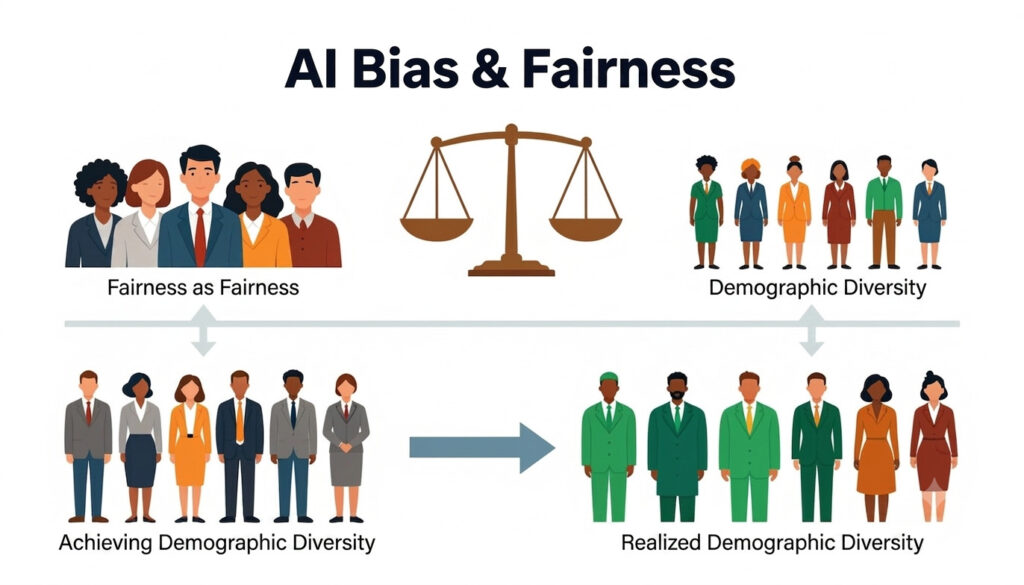
Nigerian AI engineers must consider local contexts. Models trained primarily on Western data may not work well for Nigerian users.
Regular bias testing and diverse training data help mitigate these issues. Include fairness metrics alongside accuracy when evaluating models.
Privacy and Data Protection
AI systems often process sensitive personal information. Protecting user privacy requires careful system design and data handling.
Understand Nigeria’s data protection regulations. The Nigerian Data Protection Regulation establishes requirements for handling personal data.
Implement privacy-preserving techniques like differential privacy when appropriate. Minimise data collection to only what’s necessary for your use case.
Be transparent about data usage. Users deserve to know how their information trains and improves AI systems.
Transparency and Explainability
Many AI models operate as “black boxes,” making decisions without clear explanations. This opacity creates problems for high-stakes applications.
Loan decisions, medical diagnoses, and hiring recommendations should be explainable. Affected individuals deserve to understand why systems made particular choices.
Techniques like LIME and SHAP help explain model predictions. Invest time in understanding these methods for deploying transparent systems.
Balance model complexity with explainability requirements. Sometimes simpler, more interpretable models serve better than slightly more accurate complex ones.
What ethical responsibilities do AI engineers have?
AI engineers must ensure their systems treat all users fairly, protect privacy, remain transparent about capabilities and limitations, and avoid causing harm. This includes testing for bias, implementing privacy protections, documenting system behaviour, and considering potential misuse cases.
How can I detect bias in my machine learning models?
Test model performance across different demographic groups. Compare accuracy, false positive rates, and false negative rates between groups. Use fairness metrics like demographic parity and equalised odds. Examine training data for representation gaps. Tools like Fairness Indicators and AI Fairness 360 help systematically evaluate models.
What should I do if I discover my model exhibits bias?
First, document the bias thoroughly. Then explore mitigation strategies: collecting more balanced training data, using bias correction algorithms, adjusting decision thresholds per group, or implementing fairness constraints during training. Sometimes the ethical choice is not to deploy a biased model until you can address the issues properly.
How do I balance model performance with ethical considerations?
Ethical AI doesn’t always require sacrificing performance significantly. Often, fairer models perform comparably to biased ones. When trade-offs exist, consider the application context. For high-stakes decisions affecting people’s lives, prioritise fairness and transparency even if it means slightly lower accuracy.
Building Responsible AI Practices
Establish ethics reviews for AI projects before deployment. Consider potential harms and mitigation strategies systematically.
Involve diverse stakeholders in system design. Different perspectives help identify issues you might miss alone.
Document decisions, assumptions, and limitations clearly. Future engineers maintaining your systems need this information.
Stay informed about ethical AI guidelines and best practices. Professional responsibility requires continuous learning in this area.
Inspiring Success Stories from Nigerian AI Engineers
Real examples prove that breaking into AI engineering without traditional credentials is entirely possible. These stories demonstrate various pathways to success.
Each journey differs, but common themes emerge: dedication to learning, consistent project work, and active community engagement.
From Banking to AI Engineering
Tunde worked as a bank teller in Ibadan for three years after studying business administration. Frustrated with limited career growth, he discovered machine learning through online courses.
He spent evenings and weekends learning Python and completing Andrew Ng’s course. After six months, he started building projects and analysing financial data.
His portfolio included a loan default prediction model and customer churn analysis. These projects, directly relevant to banking, caught attention when he applied to fintech companies.
Eighteen months after beginning his learning journey, Tunde secured an AI engineering role at a Lagos fintech startup. His banking knowledge, combined with new technical skills, made him valuable.
Physics Graduate Becomes Computer Vision Specialist
Ngozi studied physics at the University of Nigeria, Nsukka. After graduation, she struggled to find fulfilling work in her field.
Her mathematical background helped her grasp machine learning concepts quickly. She focused specifically on computer vision after completing the Fast.ai course.
Ngozi built agricultural applications using computer vision. Her projects included cassava disease detection and crop yield estimation from satellite imagery.
These practical solutions addressing Nigerian agricultural challenges impressed employers. She now works as a computer vision engineer at an agritech company, combining AI with her interest in food security.
Self-Taught Engineer Goes International
Ibrahim never attended university. After secondary school in Kano, he taught himself programming through free online resources.
His journey into AI began with DataCamp courses, followed by specialised machine learning study. He participated actively in Kaggle competitions, gradually improving his rankings.
A top-ten finish in a major competition caught international attention. Companies noticed his skills despite his unconventional background.
Ibrahim now works remotely for a European AI company whilst living in Nigeria. His story proves that skills and determination matter more than formal credentials.
These engineers share one critical trait: they didn’t wait for perfect circumstances or complete knowledge. They started learning, building projects, and applying for opportunities whilst still developing their skills. Progress, not perfection, leads to success.
Your Practical Next Steps: Getting Started Today
Understanding the path matters little without taking action. These concrete steps help you begin your AI engineering journey immediately.
Start small, but start now. Consistent daily effort compounds into significant progress over months.
This Week: Foundation Building
Install Python and set up your development environment. Use Anaconda for easy package management and Jupyter notebooks for interactive coding.
Enrol in Andrew Ng’s Machine Learning course on Coursera. Complete the first week’s lectures and assignments.
Create accounts on GitHub, Kaggle, and LinkedIn. These platforms will host your portfolio and connect you with the community.
Join Nigerian AI communities on WhatsApp, Telegram, or Facebook. Introduce yourself and start engaging with discussions.
This Month: Skill Development
Complete at least half of the Machine Learning course. Don’t rush through just to finish—understand the concepts thoroughly.
Build your first simple project. Create a basic linear regression model predicting something that interests you.
Start following AI researchers and practitioners on Twitter. Read articles shared by the community to broaden your knowledge.
Attend at least one online or local meetup. Observing others’ journeys provides motivation and insights.
Next Three Months: Project Portfolio
Complete the foundational course and start applying your knowledge. Build three complete projects demonstrating different machine learning techniques.
Document each project thoroughly on GitHub. Write README files explaining your approach, results, and learnings.
Start learning a deep learning framework. Choose PyTorch or TensorFlow and work through official tutorials.
Begin contributing to discussions in online communities. Answer questions where you can and ask thoughtful questions about concepts you’re learning.
Six to Twelve Months: Job Preparation
Deepen your specialisation in your chosen area. Build advanced projects demonstrating expertise.
Polish your portfolio and create a personal website showcasing your work. Write blog posts explaining your projects.
Start applying for junior positions and internships. Don’t wait until you feel completely ready, you’ll learn through the interview process.
Network actively with people working in AI roles. Reach out for informational interviews and advice.
- Set up your development environment and create accounts on key platforms
- Begin structured learning with foundational courses
- Build your first simple project within the first month
- Join and actively participate in AI communities
- Complete three to four projects within the first quarter
- Choose a specialisation and deepen your knowledge
- Polish your portfolio and start applying for positions
- Network consistently and seek mentorship opportunities
Final Thoughts: Your Path Forward
Breaking into AI engineering without a computer science degree requires dedication but remains entirely achievable. Thousands of engineers worldwide have followed similar paths successfully.
Nigeria’s growing technology ecosystem offers increasing opportunities for skilled AI practitioners. The combination of global remote work possibilities and local market needs creates multiple pathways into the field.
Your background provides unique value. Domain knowledge from other fields combined with AI skills creates specialists capable of solving problems others might miss.
The journey takes time—expect twelve to eighteen months of focused effort. Progress won’t always feel linear, but consistent work produces results.
Remember that every expert started as a beginner. The AI engineers you admire today once struggled with basic concepts just as you might now.
Resources have never been more accessible. Quality education, powerful tools, and supportive communities exist online, available to anyone with internet access and determination.
Start your journey today rather than waiting for perfect circumstances. Take one small step: install Python, enrol in a course, or build a simple project.
Your unique perspective matters to the field. Nigerian AI engineers bring crucial insights for building systems that work for African contexts.
The opportunity exists right now. Demand for AI engineering skills continues growing whilst barriers to entry continue falling.
Transform your career through deliberate learning and consistent effort. Your determination matters more than any credential or background.
Begin today. Your future in AI engineering awaits.

Oke O. Michael (HND, BA, MBA, MSc) is a tech-savvy professional with experience in sales, healthcare, digital marketing, and business development. A skilled editor and passionate web designer, he combines strong technical insight with creative problem-solving to deliver impactful digital and business solutions.